India - Telia Rumal
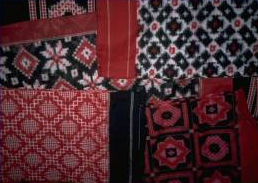
An assortment of various patterns |
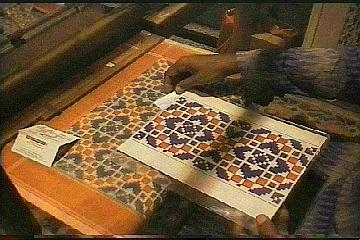
Telia Rumalsof Chirala, Puttapaka and Ponchampalli. These double ikat squares were created in a small area of Andra Pradesh using an unusual combination of Alizarin, iron or indigo and numerous vegetable oils in the process. The colours were all a variation of red, pink or purple depending on the oil mordants used. The name Telia means oil and Rumal means handkerchief or square. The finished cloth has a strong oil smell. These were used by fishermen as turbans and loincloths as well as by nobility. The history of this technique has not been recorded before 1955. Therefore it is interesting trying to find remaining practitioners who can add to the scant knowledge in print. These weavers find their children are not interesting in carrying out this traditional craft, as the time consuming process is not economically rewarding. |
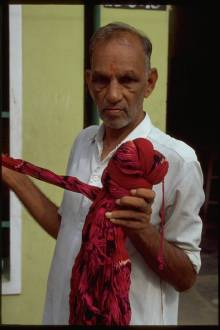
Mr Gunti Bhasker Rao |
Chirala, is thought to be the town where this weaving craft began. Out of a population of 100,000 there are 20,000 hand weavers, but only one family until recently involved in the Telia Rumal. Mr. Gunti Bhaskara Rao who worked with his brother, now deceased, stated that it took them one month to complete the dyeing process for one warp of Telia rumal yielding 8 pieces each about one metre square. Then of course the weft must be dyed before the actual weaving can begin. They had been doing the dyeing and had 6 weavers in the village to complete the cloth. However they are all over 65 years old and have retiring from this work. This finishes a craft that 50 years ago had several thousand weavers in full time production. The designs, mainly divided up into grids, varied according to location. Near Hyderabad mainly small geometric designs were used. However in Chirala they included figurative work including modern images airplanes, Victrolas (early record players) and clocks. I found it interesting to collect many different examples of this fabric. |
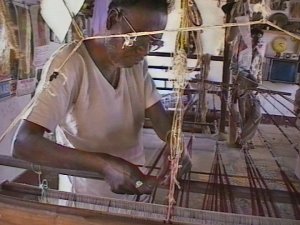
Mr. Chiluveru Ramalingum, who has is no longer alive. |
In Ponchampalli, a small village with hundreds of weavers, I found one more weaver, Mr. Chiluveru Ramalingum, actually doing this entire process with the alizarin dye. His skill and fineness of detail have earned him National Awards and prestige . There are other weavers who continue the style, but have switched to chemical dyes which save an enormous amount of time. I learned that the demise oft this craft began when Manchester textile mills started printing imitations of this cloth and taking over the export market to Arab countries that had kept this skill thriving earlier this century. A piece of this printed fabric was so well done that I had not picked it out as imitation. Modern designers are using the style and motifs of Telia Rumals and adapting them for use today as yard goods, saris, and articles of home furnishing. This is helping to expand the market and preserve the skill of the resist dyeing, if not the actual dyeing process. |
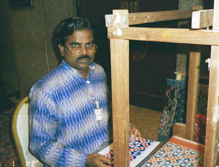
Mr G. Goverdhana demonstrating Telia Rumal at the International Ikat Symposium in Sarawak He has now given up weaving to run a handloon cloth business along with his 4 brothers. They trade as the Murali Saree Emporium, Dilsukhnagar, Hyderabad and can be contacted by fax 91 40 2406 6920 or phone 91 40 2406 7062. In their personal collection are many fine old pieces of interesting design and colour showing the diversity of image within the framework of the craft. Some of their pieces have been sold to major museums with textile sections around the world. |
Puttapaka
|
Demonstration
loom with graphed design for tie-dyeing |
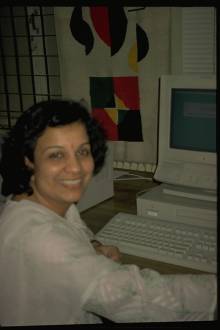
Bina Rao is a designer, trained at the National Design Institute in Ahmedabad, Gujarat. Her trained eye has seen the value in Telia Rumals as a design element and has proceeded to adapt for modern usage. She uses computer graphics to prepare work for village weavers to produce. This modern day approach is helping to preserve these skills. |